
Air-to-air heat pumps in Glasgow
Around a third of the running cost of electric heating, working down to −15 °C. Installed across Glasgow and up to 60 miles around by a Gas Safe and F-Gas certified team who will tell you honestly whether it suits your home.
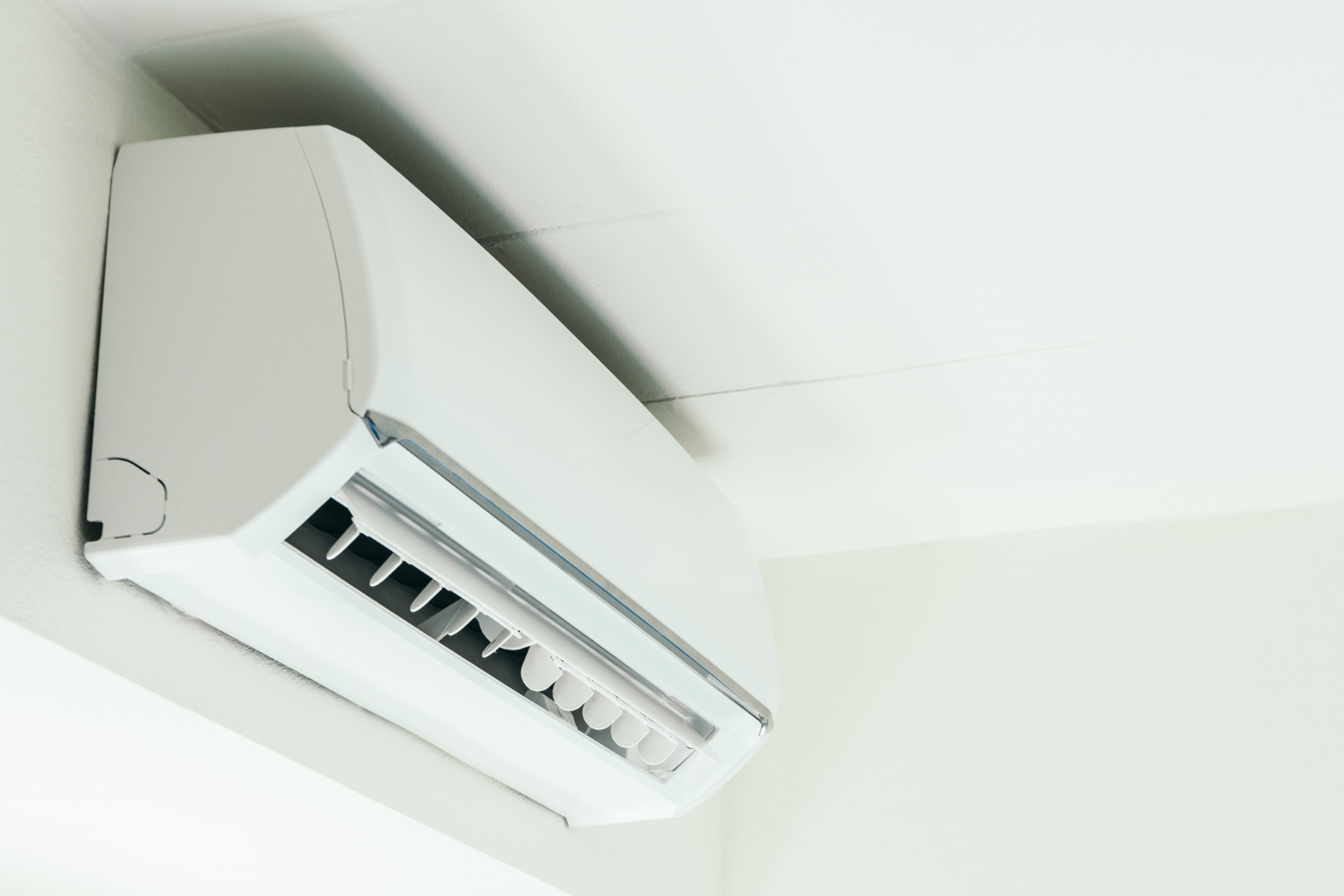
It is the same box most people call air conditioning
An air-to-air heat pump and a modern split air conditioning system are the same equipment. The difference is which job you bought it for.
It does not burn anything and it does not generate heat the way an electric heater does. It moves heat from one place to another. In winter it pulls warmth out of the outside air — there is usable heat in air well below freezing — and delivers it into your room. In summer it runs the cycle backwards and takes heat out.
The reason this matters on your bill is simple. An electric heater turns 1 kW of electricity into 1 kW of heat, and it cannot do better. A heat pump moves roughly 3 to 4 kW of heat for every 1 kW it consumes in mild conditions. You are paying to move heat, not to make it.
Performance drops as it gets colder, which is honest to say and often left out. At around freezing a good unit still returns roughly 2.5 to 3 kW per kW. On the coldest handful of nights a Scottish winter throws at you, closer to 2. Even then it beats an electric heater comfortably.
Quick facts
- Works down to
- Around −15 °C outside.
- Heats a room in
- Minutes, not an hour.
- Hot water
- No — heating only.
- Also cools
- Same unit, summer months.
- Install time
- Usually one day.
What it actually costs to run
The number that matters is not the price per unit of electricity — it is the price per unit of heat delivered into the room. Illustrative figures below use 27p per kWh for electricity and 7p per kWh for gas.
| Heat source | Efficiency | Cost per kWh of heat |
|---|---|---|
| Air-to-air heat pump | 300–400% | 7–9p |
| Gas boiler | ~90% | ~8p |
| Electric panel heater | 100% | 27p |
| Electric fan heater | 100% | 27p |
| Oil-filled radiator | 100% | 27p |
Two things follow from that table, and we would rather you heard them from us than found out later.
Against electric heating the case is overwhelming. If you are currently heating an extension, a loft room or a flat with panel heaters, a heat pump will cut that cost to roughly a third. This is where almost all of our heat pump work comes from.
Against a working gas boiler the case is much thinner. Per unit of heat the two land in the same territory. Ripping out a functioning boiler to install air-to-air units rarely pays back, and we will say so. Where it does make sense is heating a room the boiler serves badly — the cold extension, the converted loft, the garden office — without the expense of extending pipework and adding radiators.
Where it makes sense
Six situations account for almost every air-to-air installation we do in Scotland.
Extensions and garden rooms
Extending the central heating means pipework, a possible boiler upgrade and disruption. One heat pump on the wall heats the space from day one and cools it in summer.
Loft conversions
Lofts are the worst of both worlds — freezing in January, unbearable in July. A single unit fixes both problems, which no radiator can.
Flats without a gas supply
Where storage heaters or panel heaters are the only option, this is usually the single biggest saving available on the heating bill.
The room the boiler never warms
Every house has one — end of the run, north-facing, big windows. Cheaper to treat that room directly than to rebalance an entire system.
Small commercial units
Salons, studios, workshops and small offices where heating in winter and cooling in summer both matter, and where a boiler is not practical.
Taking the boiler off in autumn
In October and April, heating one occupied room with a heat pump often beats firing the whole system for the sake of the living room.
Air-to-air or air-to-water? And what about the grant?
This is where a lot of people get caught out, so here it is plainly.
An air-to-water heat pump replaces your boiler. It feeds radiators or underfloor heating and it makes your hot water. It is a whole-house system, it costs considerably more, and it is the type the Scottish grant scheme is built around.
An air-to-air heat pump — what this page is about — heats the air in a room directly. It is far cheaper, far quicker to fit, and it also cools in summer. What it does not do is make hot water.
That last point decides the grant question. The Home Energy Scotland Grant and Loan requires the system to provide 100% of your home’s heating and hot water, through an MCS-certified installation. An air-to-air heat pump does not produce hot water, so it does not meet that condition and is not eligible for the grant.
If whole-house heating and the grant are what you are after, air-to-water is the conversation to have — and we will point you toward an MCS-registered installer rather than pretend otherwise. If you want one or two rooms sorted properly, without the cost and upheaval of replacing your heating system, air-to-air is very hard to beat.
Grant terms change. Check current eligibility with Home Energy Scotland before making a decision. Last reviewed August 2026.
Side by side
- Air-to-water
- Replaces the boiler · heats water · whole house · grant eligible · higher cost
- Air-to-air
- Heats rooms directly · no hot water · room by room · no grant · also cools · lower cost
Planning permission — where heating use works in your favour
Scottish permitted development, Class 6H, covers air source heat pumps used only for providing domestic heating or hot water. A system specified and used for heating meets that condition, where a cooling-only installation generally does not.
The right still comes with limits:
- Only one air source heat pump per building or curtilage
- Mounted on the dwelling, it must not protrude more than 1 metre from the outer surface of the wall, roof plane, ridge or chimney
- Standing in the garden, it must not sit forward of a principal or side elevation fronting a road, and must not exceed 3 metres in height
- In a conservation area, ground floor level on the rear elevation only
- Not permitted within the curtilage of a listed building or in a World Heritage Site — a listed building needs planning permission and listed building consent, as two separate applications
- The unit must comply with MCS 020 planning standards, which include a noise assessment at your neighbour’s nearest habitable room window
Two things sit outside the planning question and catch people out. A building warrant from Building Standards is a separate consent and is usually needed as well. And householder rights cover dwellinghouses and residential flats only — a short-term let or commercial premises is assessed under the non-domestic rules in Circular 2/2024 instead.
We check your specific property at the free survey and set out in writing which of these applies before any work is booked. Where you want the position confirmed in law rather than in our opinion, the council issues a Certificate of Lawfulness — a formal decision notice confirming the installation is lawful without planning permission. We prepare and submit it for you.
Based on Class 6H of the Town and Country Planning (General Permitted Development) (Scotland) Order 1992 as amended, Scottish Government Planning Circulars 1/2024 and 2/2024, and written guidance from Glasgow City Council Planning. General guidance only, not a legal opinion — every property differs and only the council can issue a decision, so we confirm the position for your address before any work is booked. Last reviewed September 2026.
Installed prices
Including materials, labour, commissioning and VAT. A single room is usually a one-day job.
We specify the model at the survey based on the room, its glazing and how you use it — not on what happens to be in the van. Pipe run length, access, wall construction and electrical supply all move the final figure; we set it out in full on our air conditioning installation page →
Frequently asked questions
Will it actually keep a room warm in a Scottish winter?
Yes. Modern units are rated to around −15 °C, which is below anything central Scotland sees in a typical year. Output and efficiency fall as the temperature drops, so we size the unit for the coldest realistic conditions rather than for a mild day — that sizing decision is what separates a system that copes from one that struggles.
Can it replace my boiler?
Not on its own. An air-to-air heat pump heats the air in the rooms where units are fitted and does not produce hot water. Most of our customers keep the boiler for hot water and whole-house heating, and use heat pumps for the rooms the boiler serves badly. If you want to replace the boiler entirely, air-to-water is the system to look at.
Am I eligible for the Home Energy Scotland grant?
Not for an air-to-air system. The grant requires an MCS-certified installation providing 100% of your heating and hot water, and air-to-air does not produce hot water. Air-to-water heat pumps are the type the scheme is aimed at. Check current terms with Home Energy Scotland directly.
How noisy is it inside?
Indoor units start from around 19 dB(A) on their lowest setting, which is quieter than a fridge and well below the level of a running radiator system with air in it. The outdoor unit is the one that matters for neighbours, and we position and specify it with the MCS 020 noise assessment in mind.
Does it dry the air out like electric heating does?
Less than a fan heater, and in cooling mode it actively removes moisture. In heating mode it is moving air around rather than burning oxygen off a hot element, so most people find rooms more comfortable rather than less.
What maintenance does it need?
Filters cleaned every couple of months, which takes a minute and you can do yourself, plus one professional service a year. The annual service keeps efficiency up, keeps the manufacturer’s warranty valid and catches refrigerant loss early, which is both an environmental and a legal matter.
How long does one last?
Typically 12 to 15 years with annual servicing, similar to a boiler. Manufacturer warranties on the systems we install run to 5 to 7 years when registered and serviced annually, and we register yours on the day.
Can it go in a flat?
Often, but it needs more care than a house. The questions are where the outdoor unit can be mounted, whether the factor or other owners need to consent, and whether the building is in a conservation area. We survey flats across the West End and Southside regularly and will give you a straight answer at the visit.
Find out if it suits your home
Free survey, honest answer. If a heat pump is not the right call for your room we will tell you what is — even when that means we do not get the job.
We cover Glasgow, Cambuslang, Rutherglen, East Kilbride, Hamilton, Motherwell, Paisley, Bearsden, Newton Mearns and out to Stirling, Falkirk and Kilmarnock. Prefer to talk? Call 07706 194924, Mon–Sat 8am–6pm.