
Air conditioning installation in Glasgow
Cool in summer, warm in winter. Fixed-price installation from a Gas Safe registered heating team — with the Scottish planning rules checked before you commit.
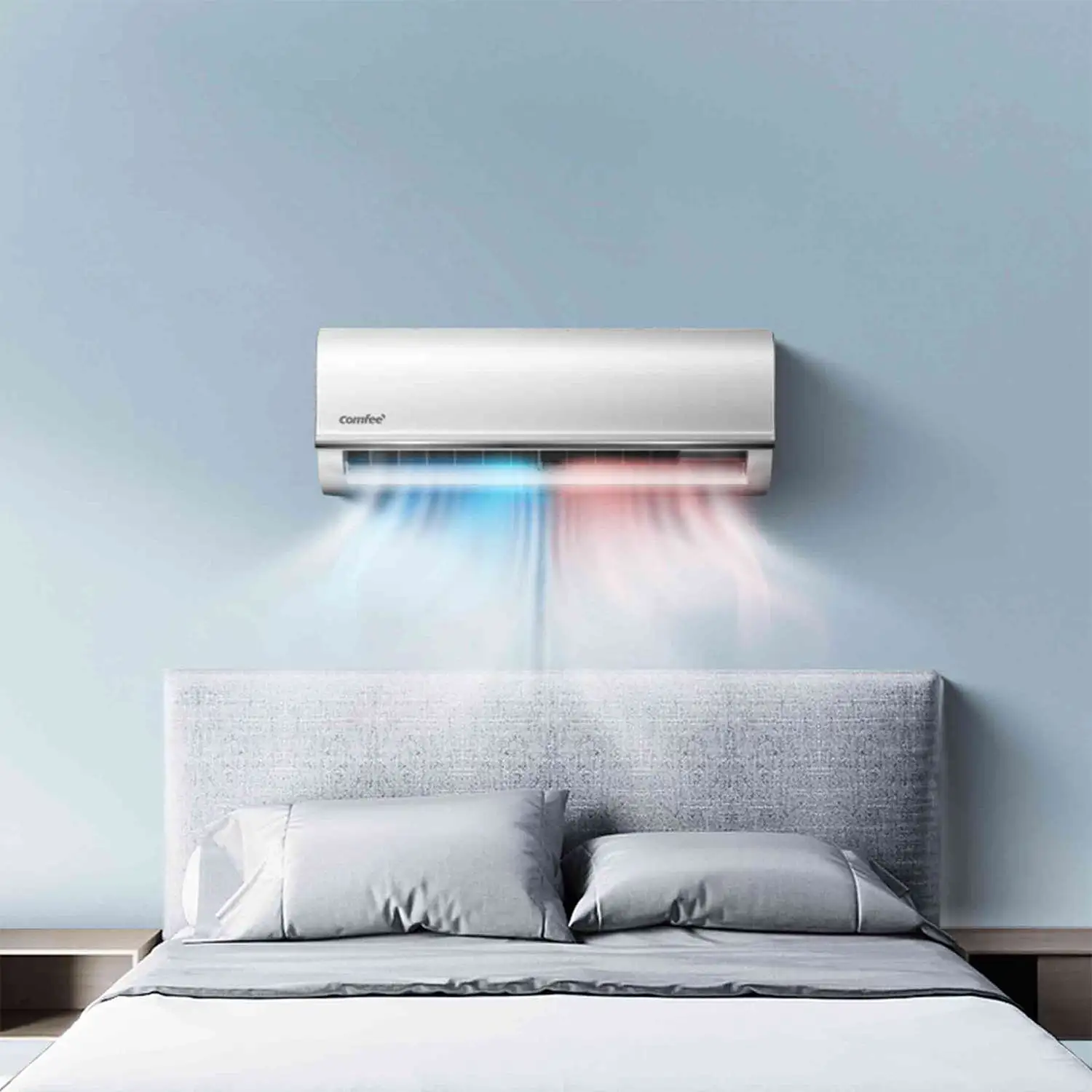
One system, two jobs — cooling in summer, heating in winter
Most people call it air conditioning. Technically, a modern split system is an air-to-air heat pump — and that matters more than it sounds.
In summer it takes heat out of your room and moves it outside. In winter it does exactly the same thing in reverse, pulling warmth from the outside air and delivering it indoors. Modern units keep working down to around −15 °C, which covers a Scottish winter comfortably.
The efficiency is where it gets interesting. In mild conditions a good system typically returns around 3 to 4 kW of heat for every 1 kW of electricity it uses. An electric heater returns 1 kW for 1 kW. On a cold February evening, that difference shows up on your bill.
This is also why we look at air conditioning differently from a refrigeration company. We are heating engineers first. When we size a system we are thinking about how it works alongside your boiler and your radiators — which rooms it should serve, which it should not, and whether it genuinely earns its place in your home.
In plain terms
- Summer
- Cools a room in minutes.
- Winter
- Heats it for roughly a third of the cost of an electric heater.
- All year
- Filters and dehumidifies the air.
What we install
Four system types cover almost every home and small business we visit. We recommend a specific model at the survey, based on the room — not on what happens to be in the van.
Wall-mounted split
The standard choice for a single room. One indoor unit on the wall, one compact unit outside, connected by refrigerant pipework.
- Output2.0–3.5 kW
- SuitsBedroom, office
- Noisefrom 19 dB(A)
- Install time1 day
Typical installed price£1,595 – £2,450
Multi-split
One outdoor unit serving two to five indoor units. Fewer condensers on the outside wall, which also matters for planning approval.
- Rooms2–5
- SuitsFamily homes
- ControlPer room
- Install time1–2 days
Typical installed price£3,250 – £5,600
Cassette & ducted
Equipment out of sight. Cassettes sit flush in a suspended ceiling; ducted systems hide entirely with only the grilles visible.
- SuitsShops, salons
- RequiresCeiling void
- ControlWall or app
- Install time2–3 days
Typical installed price£2,900 – £6,200
Air-to-air heat pump
The same equipment, specified with heating as the priority rather than cooling. Common in extensions, converted lofts and garden rooms.
- Works down to−15 °C
- SuitsExtensions
- Heats room inMinutes
- Install time1 day
Typical installed price£1,750 – £2,600
Prices include supply, installation, commissioning and VAT.
How much does air conditioning cost in Glasgow?
We would rather give you a straight answer than ask you to fill in a form to find out. A typical single-room system in a Glasgow home lands between £1,595 and £2,450 installed; a multi-split covering two or three rooms runs from £3,250 to £5,600. Every price on this page includes materials, labour, commissioning and VAT.
What changes the price
Pipe run length. The further the indoor unit sits from the outdoor unit, the more refrigerant pipework, trunking and labour is involved.
Access. A ground-floor rear wall is straightforward. A second-floor flat with no rear access may need scaffolding or a platform.
Wall construction. The solid stone walls common in Glasgow tenements take longer to core than modern cavity blockwork.
Electrical supply. Some installations need a dedicated circuit from the consumer unit.
Planning permission. If your property needs an application, the council fee and our supporting drawings are additional. We tell you at the survey, not afterwards.
Every quote we issue is fixed and in writing. If we have missed something, that is our problem — not yours.
Do you need planning permission for air conditioning in Scotland?
This is the question we get asked most often, and the honest answer is: often yes.
An outdoor condenser bolted to your wall changes the external appearance of the building, so in planning terms it counts as development. It needs planning permission unless a permitted development right covers it — and in Scotland the relevant right, Class 6H of the General Permitted Development Order, applies to air source heat pumps. It carries an explicit condition: the unit “must be used only for the purpose of providing domestic heating or hot water”.
A system installed purely to cool a room does not meet that condition, so it generally cannot rely on Class 6H. Specified and used as an air-to-air heat pump that heats your home, it can — which is one more reason we approach these installations as heating engineers.
Where Class 6H does apply, these limits come with it:
- Only one air source heat pump per building or curtilage
- Mounted on the dwelling, it must not protrude more than 1 metre from the outer surface of the wall, roof plane, ridge or chimney
- Standing in the garden, it must not sit forward of a principal or side elevation that fronts a road, and the structure must not exceed 3 metres in height
- In a conservation area it is only permitted at ground floor level on the rear elevation
- Not permitted at all within the curtilage of a listed building or in a World Heritage Site — a full application is required
- The unit must comply with MCS 020 planning standards, which include a noise assessment at your neighbour’s nearest habitable room window
Large parts of Glasgow are affected. The West End, Dennistoun, Pollokshields and Shawlands all contain extensive conservation areas, and flats and tenements carry their own ownership and consent issues on top.
Three things most installers never mention
A listed building needs two separate applications. Fixing a unit to the wall or roof of a listed building requires planning permission and listed building consent. They are assessed separately and both have to be granted before the work is lawful.
A building warrant is usually required as well. Planning permission and a building warrant are different consents from different teams. Most installations of this kind need a warrant from Building Standards in addition to any planning decision.
Shops, salons, offices and short-term lets follow different rules. Householder permitted development applies to dwellinghouses and residential flats. A commercial property — and that includes a flat let out short-term — is assessed under the non-domestic rights in Circular 2/2024 instead.
We check this for you as part of the free survey. We tell you before you commit whether your installation looks like permitted development, whether it needs an application, and what the realistic timescale is. Where you want that position confirmed in law rather than in our opinion, the council issues a Certificate of Lawfulness — a formal decision notice confirming the work is lawful without planning permission. We prepare and submit it for you. If a system cannot be installed legally at your property, we would rather say so at the survey than after taking your deposit.
Based on Class 6H of the Town and Country Planning (General Permitted Development) (Scotland) Order 1992 as amended, Scottish Government Planning Circulars 1/2024 and 2/2024, and written guidance from Glasgow City Council Planning. General guidance only, not a legal opinion — every property differs and only the council can issue a decision, so we confirm the position for your address before any work is booked. Last reviewed September 2026.
Quick check
- Detached or semi, rear wall, no conservation area
- Usually straightforward as a heating installation.
- Cooling only, no heating use
- Falls outside Class 6H — application normally needed.
- Tenement flat
- Factor or owners’ consent normally needed as well.
- Conservation area
- Ground floor, rear elevation only — and an Article 4 Direction can remove even that.
- Listed building
- No permitted development. Planning permission and listed building consent.
- Shop, salon, office or short-term let
- Non-domestic rules apply, not householder ones.
- Almost every installation
- A building warrant is likely to be needed as well.
How the installation works
Five steps from first phone call to a working system. No surprises in between.
Free survey
We visit, measure the room, check the wall construction, look at where the outdoor unit can legally go and ask how you actually use the space. Around 45 minutes. No charge and no pressure.
Fixed written quote
A specific model, a specific position, a specific price. Valid for 30 days. If planning permission is needed, it is stated here — not discovered later.
Planning and permissions
Where planning permission, listed building consent or a building warrant is required, we prepare the supporting information and submit it. Where we believe none is needed, we set out in writing why — and if you want that confirmed formally, we apply for a Certificate of Lawfulness on your behalf.
Installation
Most single-room systems are completed in a day; multi-split systems usually take two. We use dust sheets, core walls with proper equipment rather than improvising, and take our mess with us.
Handover and paperwork
We commission the system, show you how the controls and the timer actually work, register the manufacturer’s warranty in your name and issue your F-Gas documentation.
Areas we cover
We install across Glasgow and up to 60 miles around.
Glasgow
West End, Southside, Dennistoun, Shawlands, Pollokshields, Bearsden, Milngavie, Newton Mearns, Giffnock
Lanarkshire
Cambuslang, Rutherglen, East Kilbride, Hamilton, Motherwell, Coatbridge, Airdrie, Bothwell, Uddingston
Renfrewshire
Paisley, Renfrew, Erskine, Johnstone, Barrhead
Further afield
Stirling, Falkirk, Kilmarnock, Dumbarton, Helensburgh
Not sure if you are in range? Send us your postcode and we will tell you straight away.
Why choose FlameFox
Six reasons our customers give when we ask why they picked us.
Heating engineers who install cooling
Most air conditioning firms in Glasgow come from refrigeration or commercial HVAC. We come from domestic heating — so we can tell you honestly when a system makes sense and when the money is better spent elsewhere.
One team for heating, cooling and gas
Boiler, radiators, gas safety and air conditioning from the same engineers. One number to call, one company that knows your property.
Fixed written quotes
No day rates and no “we found a complication” phone calls halfway through the job. The price we write down is the price you pay.
We handle the planning side
Permitted development, conservation areas and noise limits all checked at the survey — before you commit a penny.
We work clean
Dust sheets down, cores drilled properly, pipework run neatly and boxed where it is visible. The outside of your house should not look like an afterthought.
Registered and insured
Gas Safe registered and fully insured. Annual servicing available for every system we fit.
Frequently asked questions
Do I need planning permission for air conditioning in Scotland?
Often, yes. The Scottish permitted development right for air source heat pumps, Class 6H, is conditional on the unit being used only to provide domestic heating or hot water, so a cooling-only installation generally falls outside it. Conservation areas, listed buildings and flats carry further restrictions. We check your specific property during the free survey and tell you before you commit.
Can air conditioning heat my home as well as cool it?
Yes. A modern split system is an air-to-air heat pump and runs in reverse in winter, working down to around −15 °C. In mild conditions it typically delivers around 3 to 4 kW of heat for every 1 kW of electricity, which makes it substantially cheaper to run than an electric heater.
How much does it cost to run?
A 3.5 kW unit cooling a living room typically draws around 0.8 to 1.0 kW in normal use — at roughly 27p per kWh that works out at about 22 to 27p an hour. Used for heating in winter it is usually cheaper per hour than an electric heater. We give you an estimated running cost for your specific room at the survey.
How long does installation take?
A single-room system is usually completed in one day. A multi-split serving two or three rooms typically takes two.
How noisy is it?
Indoor units start from around 19 dB(A) on their lowest setting, which is quieter than a fridge. The outdoor unit is the one that matters for your neighbours. Where an installation relies on permitted development it has to meet the MCS 020 planning standard, which assesses sound at the neighbour’s nearest habitable room window. We position and specify units with that assessment in mind.
Can you install air conditioning in a flat or a tenement?
Often yes, but it needs more care. The main issues are where the outdoor unit can be mounted, whether you need factor or landlord consent, and whether the building sits in a conservation area. We survey these properties regularly across the West End and Southside and will give you a straight answer at the visit.
Do I need a separate electrical supply?
Smaller systems can usually run from an existing circuit. Larger and multi-split systems generally need a dedicated supply from the consumer unit. We confirm this at the survey and include any electrical work in the quote.
How often does air conditioning need servicing?
Once a year. An annual service keeps efficiency up, keeps the manufacturer’s warranty valid and catches refrigerant loss early, which is both an environmental and a legal matter.
What warranty do I get?
Manufacturer warranties on the systems we install are typically 5 to 7 years when the unit is registered and serviced annually — we register yours on the day of installation. Our workmanship is guaranteed for 12 months.
Do you install systems customers have bought themselves?
We prefer not to. If a system is undersized for the room or unsuitable for the property, we end up owning a problem we did not create. We are happy to advise before you buy.
Book a free survey
Tell us the postcode and the rooms you want covered. We will come out, measure up, check the planning position and give you a fixed written quote — with no obligation and no sales pressure. Prefer to talk? Call 07706 194924, Mon–Sat 8am–6pm.